|
 |
 |
 |
 |
 |
 |
 |
 |
 |
 |
 |
 |
 |
|
| Programa general | Teatro Degollado | Wednesday June 3 Artist: Masako Kasuga, Adrián Guerrero and Jesús Guerrerosantos Collaborators: María Luisa Hayama, Elsa Beatríz Hayama, Alicia Murakami,
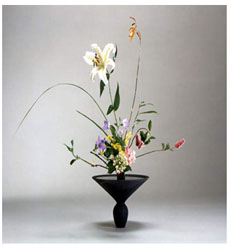
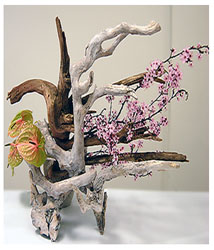
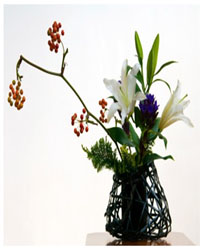
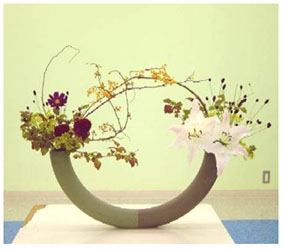
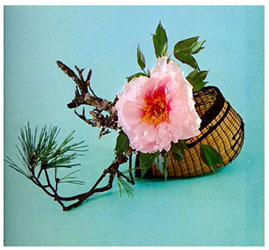
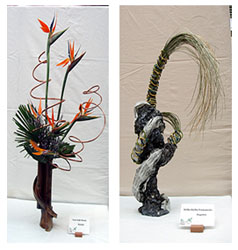
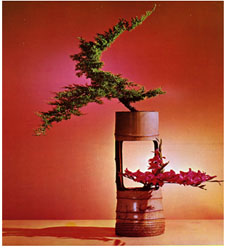
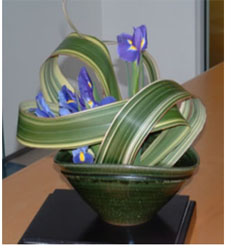
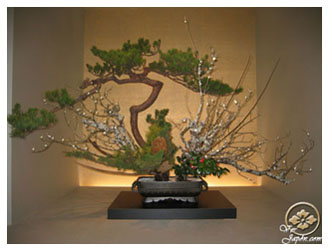
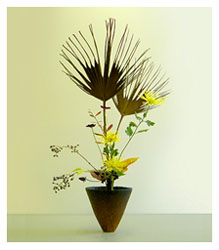
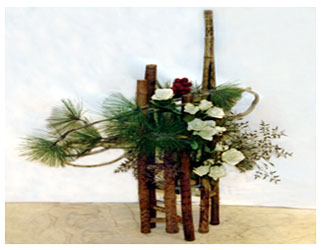
What is Ikebana? IKEBANA is the Japanese art of flower arrangement. It is more than simply putting flowers in a container. It is a disciplined art form in which the arrangement is a living thing where nature and humanity are brought together. It is steeped in the philosophy of developing a closeness with nature.
As is true of all other arts, IKEBANA is creative expression within certain rules of construction. Its materials are living branches, leaves, grasses, and blossoms. Its heart is the beauty resulting from color combinations, natural shapes, graceful lines, and the meaning latent in the total form of the arrangement. IKEBANA is, therefore, much more than mere floral decoration.
The growing appreciation of Japanese art and architecture in the West has extended to the Japanese way with flowers. IKEBANA is an art, in the same sense that painting and sculpture are arts. It has a recorded history; it is backed up by articulate theories; and it is concerned with creativity. In Japan, flower arrangements are used as decorations on a level with paintings and other art objects. Ikebana and the Japanese love of nature The remarkably high development of floral art in Japan can be attributed to the Japanese love of nature. People in all countries appreciate natural beauty, but in Japan, the appreciation amounts almost to a religion. The Japanese have always felt a strong bond of intimacy with their natural surroundings, and even in contemporary concrete-and-asphalt urban complexes, they display a remarkably strong desire to have a bit of nature near them. Foreign visitors to Tokyo are often surprised to notice that their taxi driver has hung a little vase with a flower or two at the edge of the windshield. The Japanese house that does not at all times contain some sort of floral arrangement is rare indeed.
Nature is always changing. Plants grow and put forth leaves, flowers bloom, and berries are borne regularly and repeatedly throughout the seasons. Nature has its own rhythm and order. The awareness of this is the first step in involving oneself in IKEBANA.
In principle, IKEBANA aims not at bringing a finite piece of nature into the house, but rather at suggesting the whole of nature, by creating a link between the indoors and the outdoors. This is why arrangers are likely to use several different types of plants in a single arrangement, and to give prominence to leaves and flowerless branches as well as blossoms. Even when a single type of flower is used, an attempt is made to bring out its full implications as a symbol of nature.
|