
Premiere in Mexico
Guest of honor of the Festival Cultural de Mayo,
to the premiere in Mexico of his work.
Concert for Orchestra by Richard Danielpour (1956-) (U.S.A.)
| En Español | Premiere | Go back |
RICHARD DANIELPOUR, compositor
ichard Danielpour has become one of the most sought-after composers of his generation — a composer whose distinctive American voice is part of a rich neo-Romantic heritage with influences from pivotal composers like Britten, Copland, Bernstein, and Barber. His works are "solidly rooted in the soil of tradition, yet [sing] with an optimistic voice for today... [they] speak to the heart as well as the mind".
Danielpour has commented that "music [must] have an immediate visceral impact and elicit a visceral response." This visceral element can indeed be heard throughout Danielpour's œvre: expansive, sweeping, romantic gestures; energetic rhythmic accentuations; contrasting stylistic characters; arresting, introspective, melodic beauty; rich, enticing orchestrations; and brilliantly juxtaposed, yet cohesive harmonic angles. His impact on the contemporary music scene stands firm, with an illustrious array of international champions and a reputation as a devoted mentor and educator.
Danielpour has been commissioned by some of the world’s leading musical institutions: The New York Philharmonic (Toward the Splendid City and Through the Ancient Valley); The Philadelphia Orchestra (Violin Concerto); the San Francisco Symphony (Symphony No. 2, Song of Remembrance, and the Cello Concerto); Pittsburgh Symphony (Concerto for Orchestra, celebrating the orchestra's centennial); Baltimore Symphony (The Awakened Heart); National Symphony (Voices of Remembrance); Pacific Symphony (An American Requiem, and the newly orchestrated version of A Child’s Reliquary); the Chamber Music Society of Lincoln Center (Piano Quintet and Sonnets to Orpheus, Book I, for Dawn Upshaw); Absolute Vodka (Piano Concerto No. 2); the Santa Fe Chamber Music Festival (Sonnets to Orpheus, Book 2); and most recently the Isaac and Linda Stern Foundation (River of Light, for violinist Sarah Chang).
Forays into the world of theatre have yielded two ballet commissions: Urban Dances for the New York City Ballet’s “Diamond Project”, and Anima Mundi for the Pacific Northwest Ballet. And in the world of opera, Danielpour’s first opera Margaret Garner (written in collaboration with Nobel Laureate librettist Toni Morrison) achieved critical acclaim upon its premiere in May 2005 at the Michigan Opera Theatre. Directed by Kenny Leon and conducted by Stefan Lano, Margaret Garner featured celebrated mezzo-soprano Denyce Graves in the title role, and continued through the following season with subsequent performances mounted by co-commissioners Cincinnati Opera and Opera Company of Philadelphia.
Among Danielpour's awards are a Guggenheim Foundation Fellowship, the Charles Ives Fellowship and a Lifetime Achievement Award — both from the American Academy of Arts and Letters, five Macdowell Colony Fellowships, a Jerome Foundation Award, and a Rockefeller Foundation Grant.
As an educator, Danielpour serves on the faculties of both the Curtis Institute of Music and the Manhattan School of Music, while also participating in master classes and residencies around the country.
Danielpour studied at the New England Conservatory and at the Juilliard School. His teachers have been: Vincent Persichetti, Peter Mennin, and John Heiss (composition), Benjamin Zander (conducting), and Lorin Hollander, Veronica Jochum, and Gabriel Chodos (piano).
PRESS
“…a brilliant composer, who is unafraid to let his emotions show and who possesses the skill to bring off grand orchestral effects”. |
Richard Danielpour:
Concerto for Orchestra (1996)
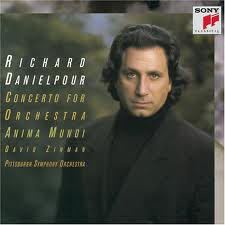
Richard Danielpour´s Concerto for Orchestra joins a small handful of works that have made their debuts on recording prior to being heard in concert. The four-movement concerto was one of the last of the Pittsburgh Symphony Orchestra´s 100th anniversary commissions, and came about through a conversation Danielpour had with the orchestra´s pops conductor. Marvin Hamlish, and the Pittsburgh Symphony´s general manager, Gideon Teoplitz. Most of it was composed between December 2 and 20 of 1995; the first 40 bars were rewritten at the beginning of 1996; and the full score was completed between February and April. Recording sessions took place on July 5 and 6 1996 and, finally, the piece received its world premiere on May 16, 1997.
| Top |