Premiere in Mexico
| ELEMENTS by Michael McLean (U.S.A.) |
| En Español | Premiere | Go back |
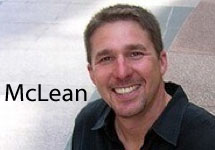
MICHAEL MCLEAN (United States)
MICHAEL McLEAN is a Composer, Violinist, and Teacher based in Los Angeles, California. In all capacities, he has proven himself adept at connecting with his audience. Music remains a powerful medium with a unique capacity to elevate us, and as a tool in the composer’s hands, music may be crafted to communicate a direct universal message. For Michael, sharing with and reaching his audience musically is his highest purpose. As a multi-faceted musician, it has been Michael's privilege to travel throughout the United States and the wider world, exploring and sharing his unique musical vision for the 21st century.
Michael discovered music at an early age and eventually followed his passion to Northwestern University. While there, he majored in violin performance, but also extensively studied composition, counterpoint, and orchestration. Michael has taught violin at the Music Institute of Chicago and was Adjunct Professor of Violin at Texas Christian University from 1994-1997. A turning point came when Michael studied Suzuki pedagogy with Yuko Honda, Barbara Barber, and John Kendall. Already an accomplished violinist, Michael discovered the joy of sharing his world of music with young students. He continues as an active member of the Suzuki Association of the Americas. Subsequently, Michael completed the prestigious program, “Scoring for Motion Pictures and Television,” at the University of Southern California.
AS A COMPOSER of concert music, Michael’s Violin Concerto, Elements, for Violin and String Orchestra, was recently recorded with the London Symphony Orchestra at Abbey Road Studios with Brian Lewis as the featured soloist and Hugh Wolff conducting; the work was released by Delos in 2006. His Suite for Viola and Orchestra, commissioned by Violist, Roger Myers, was recently premiered at the prestigious Sunflower Festival in Kansas to rave reviews; the work will be recorded in 2009.
ON THE FACULTY at the Colburn School of Performing Arts, Michael found a framework to bring his talent and training together. He teaches violin and conducts various ensembles throughout the school. Heenthusiastically shares his passion for music with his students as he strives to help them bring out their personal best. Michael keeps his approach to teaching fresh and vibrant by maintaining a lively career as a composer of orchestral, chamber, and film music.
AS AN INFLUENTIAL EDUCATOR, Michael is a popular guest clinician at workshops and Institutes throughout the country. He has recently been invited to teach and perform in Argentina, Singapore, Tanzania, Japan, and Belgium. He has found that music is, indeed, “...The universal language of mankind.” Michael’s teaching approach has been widely appreciated in the Americas and beyond. He is always grateful to bring the richness of those experiences back to his students at home.
ELEMENTS by Michael McLean
“The initial inspiration for Elements (2004) came to me after I had finished a recording project with Brian Lewis. I was truly mesmerized by Brian´s stunning tone production and knew, at that moment, that I had to write a concerto-type piece for him. I was also deeply engrossed in the writings of Carl Jung, and so the idea of the four elements and their deep spiritual symbolism became the organizing principle for this initial inspiration”.
The four element –earth, fair, air and water- not only serve as ideas for exploring the undercurrents of archetypal energy, but also are expressed musically in a literal sense, tonal pictures of the elements as seen on their surface.
Earth follows a simple ABA form with the insertion of a violin cadenza preceding the B section. Evoking the creation of the earth from the biblical Genesis story, this movement uses chant-like polyphony reminiscent of Sixteenth-Century counterpoint. The entrance of the solo violin heralds a moment of divine inspiration, “and God created man”. And so, the violin solo, representing prototypical man, or “Adam”, is allowed to explore the earth. Our experience is portrayed in the musical motif of the middle B section, the upward motion of the melodic material suggests our sometimes agonizing search for truth and self-knowledge. The movement and with a poignant violin obligato, a surrender to the life condition and our eventual return to the source.
Written in a dance-like form, Fire was in part inspired by one of my favorite film score composers, Bernard Hermann, who composed for may Hitchcock films (Psycho, Vertigo, North by Northwest). It is a devilish dance for violin and strings, evoking the images and feel of fire. An initial spark starts the fire, which ignites into a larger and larger conflagration. Fire, read symbolically, represents both the creative and destructive elements, again the cycle of birth and death.
A stark contrast was needed after the manic frenzy of Fire, and so Air evokes the ethereal effect of clouds on which the violin, or Spirit, floats above –a meditation of peace and synchronicity. Musically, I wanted to explore the many possibilities of the violin´s upper register, as well as various compositional techniques (12tone, etc.). The prevailing motivic idea, being the upward sweep of scales and arpeggios, suggest not only the sonic picture of floating skywards, but also reminds us of our constant spiritual evolution, our spirit vibrating at en ever higher frequency.
Water references the symbol for the subconscious which, in a mythological rendering, would be depicted as the “Underworld”. The opening uses the minimalist devices of repetition and slow paced chord changes, beginning with pizzicato violins as raindrops. A small “stream” develops which, as the full ensemble enters, grows into a larger, wilder “river”. One can hear the spray of fountains and other water-like devices in the interplay between the solo violin and tutti violins. The development section takes us on a journey deep into a dream-like landscape, a trip to the dark regions of the underworld. Here, like the Hero´s journey, the inner conflicts are made know and confronted, and as the violin solo “breaks through”, we are in the realm of psychological integration, where the elements of earth, fire, air and water are heard together in a moment of musical transcendence.
-Michael Mc Lean
| Top |