Premiere in Mexico
|  Español | Premiere | Go back |
Philip Glass, David Dzubay, Daniel Kellogg, Reza Vali
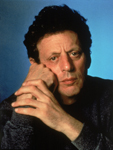 Through his operas, his symphonies, his compositions for his own ensemble, and his collaborations with artists ranging from Woody Allen to David Bowie, Twyla Tharp to Allen Ginsberg, Philip Glass has had an extraordinary and unprecedented impact upon the musical and intellectual life of his times.
The operas—Einstein on the Beach, Satyagraha, Akhnaten, and The Voyage, among others—play throughout the world’s leading houses, and rarely to an empty seat. Glass has written music for experimental theater and for Academy Award-winning motion pictures such as The Hours, while Koyaanisqatsi, his initial filmic landscape with Godfrey Reggio and the Philip Glass Ensemble, may be the most radical and influential mating of sound and vision since Fantasia. His associations, personal and professional, with leading rock, pop and world music artists date back to the 1960s. Indeed, Glass is the first composer to win a wide, multi-generational audience in the opera house, the concert hall, the dance world, in film and in popular music—simultaneously.
For Glass, such distinctions are not terribly important. To him, it is all music—period—something he creates every morning, whether the studio of his house in Manhattan’s East Village or in the hotel rooms he occupies when on tour. He is never without several projects on which to concentrate and, by now, his output runs to many thousands of hours. “It’s in my nature to write a lot of music,” he once explained, with typical understatement.
Glass has always gone his own way. Born in Baltimore in 1937, he began his musical studies at the age of eight. His father, Ben Glass, ran a record store and the young Philip was acquainted early on with the actual business of music. Small wonder that he would become one of the first composers to found his own record label— indeed, three of them to date, over the course of 35 years.
By the age of 15, Glass had matriculated at the University of Chicago, where he continued what had already become an exhaustive involvement with music. After graduation, he attended the Juilliard School, then emigrated to Paris where he studied with the legendary pedagogue Nadia Boulanger (who, in the course of her 60-year career, also tutored Aaron Copland, Virgil Thomson, Roy Harris, Quincy Jones and several other important American composers). During his time with Boulanger, Glass also explored less-conventional musical venues, and worked intensively with Ravi Shankar and the Indian tabla player Allah Rakha. This music—particularly its highly structured approach to rhythm—affected Glass’ own work profoundly.
He moved back to New York in 1967 and quickly established himself in the blossoming arts community in downtown Manhattan. There he worked as a plumber, drove a cab at night and spent his spare time assembling an early version of the Philip Glass Ensemble—seven musicians playing keyboards and a variety of woodwinds, amplified and fed through a mixer.
The new musical style that Glass was evolving was eventually dubbed “minimalism”. Glass himself never liked the term and preferred to speak of himself as a composer of “music with repetitive structures”. Much of his early work was based on the extended reiteration of brief, elegant melodic fragments that wove in and out of an aural tapestry. Or, to put it another way, it immersed a listener in a sort of sonic weather that twists, turns, surrounds, develops.
“I had to play my music myself” Glass remembered. “The musical establishment of the time thought I was crazy, and foundation support was out of the question. We’d play for free or for a small donation in old buildings where you had to climb six sets of stairs if you wanted to hear what we were doing”.
But those who responded to his music tended to become fanatical about it, and word spread about the young composer whose work sounded so unlike anything else around. Glass developed his first core following in lower Manhattan, among the writers, artists and sculptors who then peopled the dusty lofts, paying next to no rent, baking in the summer and freezing in the winter. But as his concerts attracted larger and larger audiences, museums and local galleries began to invite him to play. And then Einstein on the Beach, conceived and executed with theater visionary Robert Wilson, made Glass famous.
Einstein, presented throughout Europe and then at the Metropolitan Opera in November, 1976, broke all the traditional rules of opera. It was five hours long, with no intermission; the audience was invited to wander in and out at liberty throughout the performance. Instead of a plot, Glass and Wilson presented a poetic look at the life and legacy of Albert Einstein: scientist, humanist, amateur musician—and the man whose theories led to the splitting of the atom. Glass’ text consisted of numbers, do-re-mi’s and nonsense phrases. The stage was flooded with white light; a train moved slowly through space; a young boy threw a paper airplane, and Lucinda Childs paced back and forth, resolutely going nowhere and everywhere. There had never been anything quite like it and, 30 years on, its radical uniqueness has only become more apparent.
Since Einstein, Glass has been involved in so many diverse projects that to list them all would require several pages. He has composed more than twenty operas, large and small; eight symphonies (with others already on the way); concertos for violin, piano, timpani, and saxophone quartet and orchestra; soundtracks to films ranging from new scores for the stylized classics of Jean Cocteau to Errol Morris’s documentary about former defense secretary Robert McNamara; string quartets; a growing body of work for solo piano and organ. He has collaborated with David Byrne, Twyla Tharp, Paul Simon, Linda Ronstadt, Yo-Yo Ma, and Doris Lessing, among many others.
Most recently, the Metropolitan Opera, where Einstein on the Beach received its American premiere and which commissioned The Voyage in 1992, for the 2007–2008 season announced the co-production with the English National Opera Satyagraha to be revived. And then there are the lectures, the workshops, the appearances with the Philip Glass Ensemble and the solo keyboard performances throughout the world.
| Top |
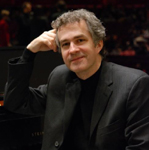 (born 1964) David Dzubay is currently Professor of Music, Chair of the Composition Department, and Director of the New Music Ensemble at the Indiana University Jacobs School of Music in Bloomington. He was previously on the faculty of the University of North Texas in Denton. Dzubay has conducted at the Tanglewood, Aspen, and June in Buffalo festivals. He has also conducted the Pittsburgh New Music Ensemble, the Greater Dallas Youth Symphony Orchestra, Music from China, Voices of Change, an ensemble from the Minnesota Orchestra, the Kentuckiana Brass and Percussion Ensemble and strings from the Louisville Orchestra at the Maple Mount Music Festival. From 1995 to 1998 he served as Composer-Consultant to the Minnesota Orchestra, helping direct their “Perfect-Pitch” reading sessions, and during 2005–2006 he was meet the Composer/American Symphony Orchestra League Music Alive Composer-in-Residence with the Green Bay Symphony Orchestra.
| Top |
 “Daniel Kellogg, barely out of his 20s, is one of the most exciting composers around – technically assured, fascinated by unusual sonic textures, unfailingly easy to listen to, yet far from simplistic.” wrote the Washington Post.After being chosen as Young Concert Artists Composer-in-Residence in 2002, Daniel Kellogg has become one of the nation’s most prominent young composers. Dr. Kellogg, Assistant Professor of Composition at the University of Colorado, had recent premieres with the Philadelphia Orchestra, the National Symphony Orchestra, the San Diego Symphony, the Colorado Symphony Orchestra, Ensemble Orchestral de Paris, the Takács Quartet with the University of Colorado Wind Symphony, and the Aspen Chamber Orchestra; and upcoming premieres with the South Dakota Symphony, the United States Air Force Academy Band, the Takács Quartet, and the choirs of Yale University.
Most recently the National Symphony Orchestra took his piece, Western Skies, on a tour of Asia.Honors include a Charles Ives Fellowship from the American Academy of Arts and Letters, a Charles Ives Scholarship from the American Academy of Arts and Letters, six ASCAP Young Composer Awards, the BMI William Schuman Prize, and the ASCAP Rudolf Nissim Award.His works have been performed at Carnegie’s Weill Recital Hall, the Kimmel Center, Lincoln Center, the Kennedy Center, China’s National Centre for the Performing Arts, and broadcast on NPR’s Performance Today and St. Paul Sundays among others.A graduate of the Curtis Institute of Music, Mr. Kellogg earned a Masters of Music and a Doctor of Musical Arts from the Yale School of Music.His teachers include Don Freund, Ned Rorem, Jennifer Higdon, Joseph Schwantner, Ezra Laderman, and Martin Bresnick. He has served as composer-in-residence for the South Dakota Symphony, Young Concert Artists, the Green Bay Symphony, and the University of Connecticut. The Washington Post counted his recent CD Beginnings, recorded by eighth blackbird, among the top five classical discs of 2004.He resides in Colorado with his wife, concert pianist Hsing-ay Hsu, and daughter Kaela.He has served on the faculty of CU since 2005. Daniel Kellogg’s music is published by Nutmeg Press, and he is represented by Young Concert Artists, Inc.
| Top |
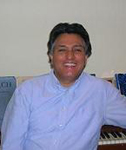 Was born in Ghazvin, Persia (Iran) in 1952. He began his music studies at the Conservatory of Music in Tehran. In 1972 he went to Austria and studied music education and composition at the Academy of Music in Vienna. After graduating from the Academy of Music, he moved to the United States and continued his studies at the University of Pittsburgh, receiving his Ph.D. in music theory and composition in 1985. Mr. Vali has been a faculty member of the School of Music at Carnegie Mellon University since 1988.
He has received numerous honors and commissions, including the honor prize of the Austrian Ministry of Arts and Sciences, two Andrew W. Mellon Fellowships, commissions from the Pittsburgh Symphony Orchestra, the Boston Modern Orchestra Project, the Pittsburgh New Music Ensemble, Kronos Quartet, the Seattle Chamber Players, and the Arizona Friends of Chamber Music, as well as grants from the Pennsylvania Council on the Arts and the Pittsburgh Board of Public Education.
He was selected by the Pittsburgh Cultural Trust as the Outstanding Emerging Artist for which he received the Creative Achievement Award. Vali's orchestral compositions have been performed in the United States by the Pittsburgh Symphony, the Seattle Symphony, the Boston Modern Orchestra Project, the Baltimore Symphony, the Memphis Symphony Orchestra, and Orchestra 2001. His chamber works have received performances by Cuarteto Latinoamericano, the Pittsburgh New Music Ensemble, Kronos Quartet, the Seattle Chamber Players, and the Da Capo Chamber Players. His music has been performed in Europe, Chile, Mexico, Hong Kong, and Australia and is recorded on the Naxos, New Albion, MMC, Ambassador, Albany, and ABC Classics labels.
| Top |